SINANGGIYAW FESTIVAL OF DUMANJUG
THE DUMANJUG PARK
History:

The municipality of Dumanjug was born more than a hundred years ago. It was in the year 1855 when the municipality was organized and had for its leader an equivalent to the latter town Captain, Pedro Ricamora. A man whose whose descendants wield some kind of political power in the municipality. He was ably assisted inthe organization of the town by benevolent friar by the name Rev. Fr. Agustine Melgar. Thus it can be said that they were the founding fathers of the municipality.
The name Dumanjug - In the older times, during the early years of the Spanish regime, there lived in the locality a tuba gatherer whose name was Roman. He was however, popularly known as Duman, a nickname given to him by the village people.
His tuba was not only the favorite of his native village because of its great special taste and quality but was also in great demand in the outlying fishing and farming villagers. No banguet would be considered successful if Duman verted more of his coconuts into tuba producing trees.
Duman was to start early at dawn to gather his tuba and the sound of his bamboo cleaner as he tapped on the coconut palm served as dawn bell for the villagers to wake up every morning. To most of them, tap-tapping sound of the cleaners as Duman cleaned his container and dexterously striking the palm with them in thymic cadence was a signal to start the day's work.
But on morning however, thymic cadence of Duman's cleaner stopped so suddenly. The villagers were surprised and ugly thoughts came to their midst. Coincidentally, it was in the instance when some Spaniards were passing by the village. They inquired about the place and was told instead that " Si Duman Nahulog " Not knowing of the local dialect the Spanish soldiers thought they were the name of the place and they proceeded to call the locality as Dumanjug, a contruction ot the statement " Si Duman Nahulog ".
Dumanjug is located in the southern part of Cebu. It is about 3 hours ride from the Cebu City. The name Dumanjug came from word "Duman" which is native person's name and "JUG" a last syllable of the word "Nahug" which means "to fall down". The name came from a historic event in this place. Duman was a local folk. He is a coconut juicer or "manananggot" in local term. One time during the spanish colonization in the Philippines, a spanish army inquired about the name of the place. On the other hand people rushed and says "Si Duman nahug", Duman fall from the coconut tree. Upon hearing it, the spanish army thought that the name of the place is "DUMANJUG".
BACKGROUND
The municipality is tagged as the “Town of Friendship” as it caters for any events as host in the south like beauty pageants, basketball tournaments, swimming competitions, dance sports, festive celebrations and more.
Dumanjug is a 4th class municipality in the province of Cebu, Philippines. According to the 2007 census, it has a population of 44,807 people. It has 27 schools offering basic education; four secondary schools; two school districts: Dumanjug Central and Bitoon Central; and three Catholic parishes: St. Francis of Assisi (Poblacion), St. Vincent Ferrer (Bitoon), and Christ the King (Bulak). It is the hometown of the Garcias, the present ruling political family of the province of Cebu.
Dumanjug is from the word, Duman which was the king of the municipality. Duman was the king and ruler of the municipality. Nahug means fallen, the cause of the king's death (Dumanjug. It is quite weird but Dumanjuganos cherished and took memories of the past. Dumanjug is near Ronda, Alcantra, Moalboal and Badian those municipalities known also for their culture and people. Meanwhile, Dumanjug is also known for the best native chiken "Bisayang manok". Many of the tourist that will go to beach nearby Dumanjug will dropby and buy that said delicious tasty chicken.
The town was established in 1855 by Capitan Pedro Ricamora and Padre Agustin Melgar. It is 74 kilometers southwest of the provincial capital, Cebu City. It has a land area of 11,958 hectares. It is bounded on the north by the town of Barili, on the east by the town of Sibonga, on the south by town of Ronda, and on the west by the Tañon Strait.
Dumanjug celebrated sinanggiyaaw every October 4 in honor of Saint Francis of Assisi. Sinangyaw means "sangi-sayaw". It is a colorful festive to give thanks to the patron saint for the good harvest of corn, fruits and vegetables. Celebrate with us every October 4 with flying colors.
Dumanjug is also known as "Town of Friendship" for Dumanjug will be the host for any events in the south such as Beauty pagents, Basketball tournaments, Swiming competitation, DanceSports, Festive Celebration and lot more.
Dumanjug also has this saying "ABANTE DUMANJUG" meaning to say moving forward. Dumanjug people are looking forward and moving forward for the progessive and peacful municipality. Dumanjug right now is a progessive municipality of the south.
Dumanjug is rich in agricultural products such as corn and vegetables,livestocks and poultries. Part of the Dumanjug is near the coastal area that is why people near the sea have the opportunity to catch fish for food and for commercial. The Tapon area has a wide area of mangrove trees. We already know that it is an excellent breeding ground for fish. They are continually planting mangrove. Tangil Dumanjug, also has smaller ships that transport passengers from Negros to Cebu.

Dumanjug is also proud of its handicrafted wall decor, basket and other native products. Most of the native products made in Dumanjug are for export. This kind of native products bring opportunities for many dumanjuganons for additional income. The raw materials used are abundant in the place. These native products are very useful and can be customized into your own basket, mats, placemats, wall decors among others. It doesn't become the signature products of Dumanjug but it is also a unique features that Dumanjug has to offer.

Dumanjug town fiesta falls every 4th of October in honor of Saint Francis of Asisi. During the celebration, school students will present their Sinanggiaw. It is a colorful dancing festival in honor of the patron saint for their good harvest of fruits, corn and vegetables. It is participated by schools in different barangays of the Dumanjug.

Dumanjug is also a developed town. It's town plaza has evolved and developed to be more alive. The town plaza of Dumanjug is one of the most visited place. It has a lot of sits in it, swing and seesaw for the kids, etc.
FESTIVAL SINANGGIYAW FESTIVAL

In cognizance of the fiesta celebration of St. Francis of Assisi, the town also celebrates the “Sinanggiyaw Festival”. The word sinanggiyaw was derived from “sinanggi” which means “harvest” and “sayaw” as a native language of “dance”. It is a thanksgiving festival to their patron for the good harvest of agricultural crops. Participants display agricultural products such as corn, coconut, camote, rice and banana in colorful costumes.
Among the things to be seen here are the ancestral homes and old houses, the town plaza, executive building and of course, the churches especially the St. Francis of Assisi Church.
TOURIST SPOT IN DUMANJUG

Dumanjug Church
( St. Francis of Assisi)
South side of Cebu next to Municipality of Barili.
This old structure was completed in 1864, as engraved at the main entrance. Its construction started in circa 1854, when the Dumanjug Mission Post was elevated into a parish.
The work was commissioned by the Spanish Bishop Romualdo Jimeno, O. P. and was undertaken by the pioneerring Pilipino Secular Priest, Rev. Fr. Matias Cabrera and Doroteo Godinez, with the freelabor support of the early natives.
The basic materials used are sea corals stone, limestone and Balayong (native black wood) which were abundant in the area then.
It is interesting to note that this is one of the few old church structures in Cebu and probably in the whole Philippines, which was designed, executed, supervised and completed by Filipinos themselves.
The year 2004 marks the 150th Founding Anniversary of the parish with St. Francis of Assisi as the titular.It is interesting to note that the church is one of the few old church structures in Cebu and probably in the whole Philippines, which was designed, executed, supervised and completed by Filipinos themselves.
DUMANJUG'S SPECIALTY
Bisayang Manok
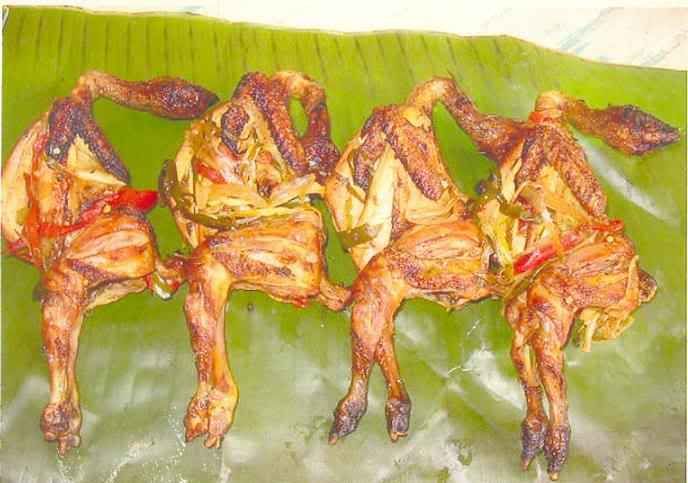
It is also popular for its very tasty “Bisayang Manok”, a native chicken deliciously cooked and only here in Dumanjug can be found. Many tourists will drop by to buy such delicacy.

No comments:
Post a Comment